Ron Harper, Jr. stands outside a political rally at Columbia High School, April 30, 2018. [Columbia Spy file photo]
A judge has ruled that the Lancaster County Board of Commissioners violated Pennsylvania’s Sunshine Act when it failed to fully identify public commenters and the subject of their remarks in published minutes describing three public meetings last year.
The ruling, filed Aug. 29, followed a 15-month legal battle in which the plaintiff, Ron Harper Jr., represented himself in court. Harper’s victory was narrow, in that county court Judge John Kuhn ruled in his favor on only one of several claims in his suit.
The judge ordered the commissioners to change minutes from 2023 meetings held April 26, May 3 and May 24. Harper successfully argued that three commenters who spoke at those meetings did not have their names and remarks adequately described in published minutes as required under the Sunshine Act. Harper was not one of the commenters referenced in those meetings.
(Click/tap on photos to see larger, sharper images.)
Out for a morning run
Abe is starting to rust
He’s on the highway marker on the 300 block of Chestnut
Look who’s on the ballot.
This surveyor took measurements at various spots around Front Street, Locust Street, and South 2nd Street the other day.
He also had an assistant.
Lights on at the historic building on Bank Street
A sign of the season?
He was on Barber Street with his master.
One foot is lighter in color than the others.
Could his name be Gordon Lightfoot?
Sunflower-shrouded signs
Fishermen on the rocks
A cock’s comb looking like an alien brain
Words to live by
Meanwhile, at Tollbooth . . .
*****************
Relaxing at River Park
A former river rescue boat repurposed for family enjoyment?
Back at Tollbooth
A truck with some messages
Water Company work on South 3rd
Trains travel in both directions, so LOOK.
At Slaymakers in Washington Boro
An interim repair project on the bridge will start on Monday and could last until November 18.
Some folks still aren’t understanding the purpose of this container. It holds empty bags to be used for dog poop. It is not a repository for USED bags.
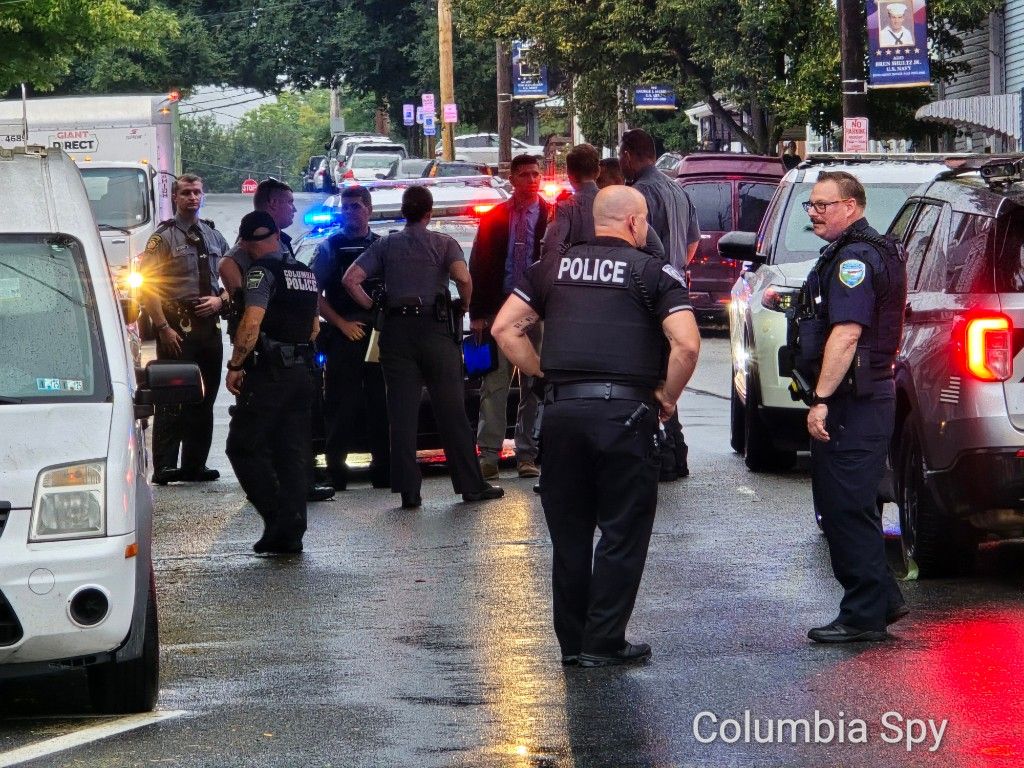
Police incident on the first block of 6th Street
Roofwork at Columbia Crossing
One of three warthogs that flew over the other day
A cat named Mizzy on Walnut Street
A Douglas DC-3 flew over Columbia this afternoon (9/8/24) on its way back to Detroit after appearing at this weekend’s airshow at Lancaster Airport.
[Spy Note: Council hasn’t adequately explained how having a single trash hauler would benefit residents.]
When: Columbia Borough Council meeting Sept. 3. Council members Joanne Price and Todd Burgard were absent.
What happened: Council members will explore contracting with a single trash hauler for the borough instead of allowing residents and businesses to choose from one of the eight companies that operate in Columbia.
Why it matters: Borough workers have a tough time keeping track of accumulated refuse because they don’t receive notification if a company stops collecting trash over an unpaid bill or if someone fails to hire a company, Heather Zink, borough president, said, adding that residents and businesses could save money if one hauler handles trash for the entire borough.
Caveat: Borough officials want to hear public comments before making any decisions.
Quotable: “We may have residents who feel strongly one way or the other,” Zink said in a Sept. 4 phone call. “This is a pretty significant change from what they’re used to.”
Why now: The owners of two of the borough’s longtime hauling companies have announced retirements, Mayor Leo Lutz said. “The time is right” to select a single company, he said. Zink pointed to excessive trash violations.
Next steps: Council asked Evan Gabel, borough solicitor, to prepare a request for proposal. Members will likely discuss whether to issue it sometime in October, allowing time for public comments. A move to a single hauler would happen near the end of this year, Zink said. MORE:
Steve Kaufhold (far left) at the June 11, 2018 Columbia Borough Council meeting, when he was codecompliancemanager for the borough.
[Columbia Spy file photo]
Columbia Borough Council will consider extending an offer of employment to Steve Kaufhold as borough manager at a starting rate of $100,000 a year, according to the September 10, 2024 council meeting agenda. The offer is contingent on background check and drug screening, with the starting date to be determined.
Kaufhold was code compliance manager for Columbia Borough from January 2017 to January 2019. According to his résumé, he is currently project manager/estimator for Lancaster County Housing & Redevelopment Authorities.
If hired, Kaufhold will fill the position left open by the resignation of Mark Stivers, which was announced in June 2024.
A new bridge would have to be built off-alignment, which would require costly alterations to the connecting streets in Wrightsville and Columbia and likely acquiring additional property for it.
Building a new bridge from scratch would move this project back to the very early stages of design.
[This article by LNP staff writer Chip Smedley originally appeared in the Lancaster Sunday News on February 15, 2009 and was updated Sep 11, 2013. A small section at the beginning was removed for relevance for this publication.]
“The failed attempt to merge Columbia and Hempfield schools, 1963-1970.”
As noted county historian Jack W. W. Loose observed, “The reasons for the failure of the Hempfield-Columbia merger were about 95 percent social and 5 percent educational. Hempfield wanted nothing to do with that borough.”
“There was something cultural there,” Loose said. “Hempfield considered itself a suburban/rural type of school district and Columbia was more urban in nature.”
Jacques Geisenberger, the attorney who served as special counsel to the Columbia School District during the merger process, was equally diplomatic.
“Hempfield was much larger, and it had a very different demographic,” he said. “Politically it wasn’t going to sell.”
Frederick H. Smedley was blunt.
As far as Hempfield was concerned, he said, “Columbia was the dregs of civilization.”
Smedley [editor’s note: he is the father of the writer of this article] was born and raised in Columbia and still lives there. But in 1939 he went to work at Landisville Junior High School as a seventh-grade teacher. Except for a World War II stint in the Army, he spent his entire career in what became the Hempfield School District before retiring as an assistant superintendent in 1981.
About those “cultural differences?”
“Columbia is a river town,” Smedley explained. “All river towns have reputations, especially those along the canal.”
Columbia’s image was rough-and-tumble from its turn-of-the-century heyday as a canal and railroad terminus.
When the merger was first broached, Smedley said, “Hempfield saw it as Columbia trying to get in on Hempfield’s money.”
Borough problem That merger was first considered in the early 1960s when borough leaders realized Columbia had a problem. The times and economic growth had passed the borough by.
Encompassing 1.6 square miles, it was the smallest borough in Lancaster County. But with 12,000 residents at the time, it was also the most densely populated.
Prospects of industrial development to increase tax revenue were slim. Grinnell Corp. (now Anvil International), the largest employer in the area, used Columbia utilities but sat just outside the borough and paid its taxes to neighboring West Hempfield Township.
Town fathers were worried.
In a 1963 meeting of educational, business and government leaders, Columbia school Superintendent Harry Smoker invoked the doom-and-gloom phrase of the era when he declared county redistricting had “placed an iron curtain” around Columbia.
Initially, Columbia sought to merge with either the Hempfield or Eastern York districts, but were quickly rebuffed by both.
Leaders appealed to county Superintendent H.K. Gerlach, who told them it was not within his authority to promote a merger, so the borough took its case to the state’s Board of Education.
In January 1965, Geisenberger took nine witnesses to Harrisburg to testify that the borough’s school system was failing.
Lancaster school Superintendent Don Glass told the board: “Columbia cannot, in its present circumstances, continue to offer an adequate educational program as we know it.”
Smoker threw his own district under the school bus.
He said the district had no central library and no trained librarian. In the absence of physical education teachers, classroom teachers supervised basic fitness requirements. Two school nurses served all of the borough’s public and parochial schools. Columbia offered no language laboratories, no vocational studies and no remedial reading programs for elementary school students.
Smoker said, “What we can afford, in personnel and in finances, is what we will offer.”
The community “has nowhere to go” Geisenberger said in his remarks to the state board.
“Neither topography, population, anticipated population changes nor any other factor validates retaining the separate district status of Columbia,” he said.
“Columbia cannot offer an up-to-date, comprehensive educational program. Each new state requirement makes the borough’s position more difficult, more unrealistic, more unjust.”
Hempfield’s opposing testimony was postponed that day because the state board had another pressing case to hear: Lancaster Township’s arguments against a mandated merger with Lancaster city schools.
In the interim, Hempfield officials showed how sensitive the issue was.
In late January, an edition of the Hempfield High School student newspaper, the “Hempfield Flash,” was distributed and then abruptly taken back by the administration.
Officials would not comment, but according to a report in the Intelligencer Journal, it became clear that an offending article summing up Columbia’s argument for the merger was the reason.
An unnamed student staff member said the paper was withdrawn because its presentation of “another side of the [merger] story” upset the administration.
An unidentified “adult” at the school said the paper was withdrawn because students had “deliberately slipped the story” into the paper without permission.
Mergers ordered The bomb dropped Thursday, June 10, 1965, when the state board decreed Columbia and Hempfield had to merge. (It also mandated, on the same day, the merger of Lancaster city and township schools.) All mergers had to take effect by July 1, 1966.
Hempfield officials complained they would have to raise real estate taxes 9 mills. They also refuted Columbia’s claims that the borough was unable to provide a quality education program.
The Hempfield board declared, “Both districts are capable of providing a comprehensive program of education.”
Hempfield, Geisenberger said, (along with Lancaster Township) appealed the board’s decision to Commonwealth Court.
Yet, the merger seemed like such a done deal that the Lancaster New Era, June 12, headlined a story, “How Merger Will Affect Hempfield, Columbia Schools.”
The article even explained how the consolidated district would go about choosing a name that would “have to be approved by the state’s Department of Education and would not … duplicate the name of any other school districts in Pennsylvania.”
The state board’s consolidation mandates to a number of districts across the state were met with lawsuits, but anti-consolidation forces were dealt a blow when, in June 1967, the state Supreme Court announced it would not hear any arguments related to school reorganizations.
Litigants continued to file cases in Commonwealth Court, further tying up reorganization efforts. The state Legislature extended the deadline for districts to meet mandated consolidations.
To move things along, county schools Superintendent Gerlach announced in August 1968, that representatives of Columbia and Hempfield should appear before the county board to present their arguments. Gerlach said the board would present its recommendation in October.
Some in Columbia, Geisenberger said, had started to get cold feet.
Hempfield superintendent “Arthur Hackman would never commit to two high schools, one in Hempfield and one in Columbia,” Geisenberger said.
People in the borough began to fear, Geisenberger said, that Columbia was going to lose its high school.
A funny thing happened on the way to the board meeting.
“Politicians got involved,” Geisenberger said.
When the county school board convened Sept. 17, the controversy ended abruptly with a whimper, not a bang.
Columbia and Hempfield officials issued a statement that said, in part, “The Boards of the Columbia Borough School District and the Hempfield Union School District have met and have agreed that it is in the best interest of both districts that each remain a separate school district.”
The Intelligencer Journal reported the members of the audience were in a state of “either shocked anger or satisfaction” depending on the district in which they lived.
Wayne Hershey, president of the Columbia Education Association teachers union said, “We believe the best interest of education would be served by a merger. We are shocked by this action and we simply cannot condone the action of our board.”
The sudden reversal confused many.
Columbia school solicitor Donald H. Nikolaus told the Intell, “Reappraisal of the respective districts’ tax base and the overall financial aspects of the question” were factors.
Hempfield, he said, “has its own financial troubles. Hempfield has building problems, Columbia does not.” Population growth in Hempfield would force new construction. “We will need only one elementary school in the next five to 10 years, certainly no more than that.”
Construction in Hempfield, he argued, would be partially paid for by Columbia residents.
“We see the millage rate going to 71 mills. We now have 45 mills’ tax on real estate in Columbia.
“The question becomes, ‘Is enough money available to pay for the good education we all want for our children?’ We believe the answer is ‘no’ from a standpoint of a merger.”
Then he offered a somewhat cryptic glimpse into the future.
“Very soon,” he said, “we will have a sizable annexation to Columbia. That is not just a mirage or a hope. It will happen.”
That was the bottom line. In 1969 Hempfield school directors announced they would not oppose Columbia’s annexation of 170 acres in West Hempfield Township, much of it occupied by what is now Anvil International. The company had announced an expansion, which would result in more tax revenue to the borough.
West Hempfield Township supervisors were not amused. They decried the annexation as part of a “secret deal” made between Columbia and Hempfield school officials to kill the merger.
In January 1970, township supervisors announced they would attempt to block the annexation.
“If the courts approve the annexation, not only will the taxpayers of this township have an additional tax load to carry, but all residents of the school district will have to make up the loss of school revenues.”
Supervisor President William Binkley said when Columbia’s annexation plans were originally announced, he believed the school district would oppose the action.
However, the supervisors’ statement said, “At no time was the township a party to this arrangement. Our position is that the school board made a deal involving many acres of land, of which they are not the sole governing body, and by such actions have undermined the financial planning of township government.”
Binkley, who wanted the public to know “the price they paid” to defeat the merger then asked for an expression of public opinion at the supervisors’ next meeting. However, his hopes for outcry against the annexation never materialized and the deal was done.
Apparently, for Hempfield residents, the loss of revenue was a small price to pay to avoid any intra-district conflicts created by a merger .
“It was nasty,” Smedley, the former Hempfield administrator, said as he recalled “midnight meetings” to plot strategies and hammer out a deal.
In the end, Smedley concluded, it was a simple decision.
“They [Hempfield] were willing to give up the assessment value of the [plant] to kill that merger.”
Frederick H. Smedley, who is quoted in this article, is the father of the writer, Chip Smedley. The younger Smedley was also a resident of Columbia and graduated from Columbia High School.
[SPY NOTE: Thanks to Bill Meley for finding this article.]



.png)




.png)

 Columbia Spy