Your faithful correspondent now takes up quill to address a matter of considerable local intrigue, one which has set hearts a-flutter and tempers ablaze.
We speak of rumors of a data center rising up on the former McGinness Airport site. Could Columbia Borough’s 41 remediated acres become a shining digital temple, complete with all its attendant promises, problems, and prevarications?
The property has attracted a single suitor, a New York company which has tendered an offer of $6.35 million. Its intentions for the property have not been formally announced, although the council president said the company specializes in “warehousing and data centers.”
Several months ago, Columbia Borough Council amended its zoning ordinance for the Light Business District to allow data centers as a use-by-right, yet councilors’ intentions remain “under wraps.”
It is worth noting, if only in passing, that the Borough’s zoning also allows warehousing (with special exception) at the site, a considerably less lucrative prospect. But it is the data center that commands our attention and ignites the imagination.
The municipal treasury, ever in need of replenishing, could expect substantial real estate tax revenue, in addition to any profits realized from the sale. One’s eyebrows, it must be said, do rise at such figures.
The infrastructure question, though, is where our story grows decidedly less romantic. These digital palaces demand power on a truly prodigious scale, with an uninterrupted electrical supply, dedicated substations, and redundant fiber connectivity of the sort that the grounds currently do not have.
What Borough officials might not reveal is the unglamorous reality of an automated, fence-encircled fortress humming loudly through the night behind locked gates. There is a considerable distance, Gentle Reader, between welcoming a data center in principle and embracing one as a neighbor in practice.
The Council is scheduled to vote on whether to accept the bid at its May 26th meeting at Columbia Borough’s Fire Hall. However, any plans for the use of the property still might not be revealed there.
Legitimate concerns are anticipated from residents at the meeting: plummeting property values, rate hikes for utilities, the ceaseless roar of industrial cooling apparatus, higher surrounding air temperatures, and occasional pungent emissions and noise of diesel generators. In short, one imagines the public comment period will teem with passionate orators. And your dedicated reporter shall be watching from afar and will post her report.
Until next time, your ever-watchful correspondent remains, as always, devoted to illuminating the affairs of our beloved community in its 300th year.
Columbia Kettle Works, 40 N. Third St., Columbia, May 14. Pass. Observed deeply scored cutting boards on both cooling units, not resurfaced or discarded as required. Observed static dust on the exhaust fan in the window above the three-compartment sink and some webbing on the ceiling and pipes above food preparation areas.
Smoked & Loaded, 149 Third St., Columbia, May 14. Pass. Coleslaw, a refrigerated, ready-to-eat, time/temperature-control-for-safety food, in the two-door cooler, was not compliant with date-marking by being labeled with a discard- or use-by date of no more than seven days and requires discarding. Observed a scrub brush and food debris inside the hand-wash sink, indicating uses other than hand-washing. The hand-wash sink is for hand-washing only. Observed single-service, single-use articles (to-go trays) stored beneath a table in the food preparation area directly on the floor, and not 6 inches above the floor. A working container of soap detergent was stored above or on the floor with single-service articles (to-go trays) in the food preparation area. A box and packets of “fry-powder” was observed stored on a shelf next to food in the food preparation area.
The former McGinness property does not appear on the map of potentially suitable locations for data center development due to its distance from suitable power lines.
JOE LINTNER | COLUMBIA SPY
Who knew what and when?
The Lancaster County Planning Commission met on May 11, 2026, with a featured presentation titled “Data Center Planning Guide Update.” The presentation, reflected in the Lancaster County Planning Department’s newly updated guide, “A Planning Guide Pertaining to Data Centers in Lancaster County, PA,” outlines how municipalities across the county should approach zoning, infrastructure, and community impact as data center proposals increase.
During the discussion, Heather Zink, Columbia Borough Council vice president and a member of the commission, said that borough officials were working with a developer. Speaking at about the 19-minute mark of the recording, Zink said: “We’re working with the developer,” a reference to the former McGinness airport parcel. At that time, no bids had been submitted to the borough, and the eventual bidder’s identity wasn’t publicly known.
The McGinness parcel: Not on the map The former McGinness airport property was conspicuously absent from the county’s data center map presented at the meeting and in the planning guide. A county official explained that the parcel is not located along electric transmission lines and is considered too far from adequate electrical infrastructure.
However, a West Hempfield parcel abutting Malleable Road, which does appear on the county map, was noted as being near transmission lines, a key factor in data center site selection.
A timeline of events August 26, 2025 — Columbia Borough passed amended zoning permitting data centers in specific locations. April 8, 2026 — A pre-bid meeting was held for the McGinness parcel. Realtor Deepa Balepur, listed as a representative of Compass Realty, was present as were borough officials and a few members of the public. April 29, 2026 — Columbia Borough Manager/Police Chief and Borough Engineer Derek Rinaldo visited the former McGinness site along with others, discussing the property. May 11, 2026 — The Lancaster County Planning Commission meeting and data center presentation took place, during which Zink referenced the borough’s engagement with the developer. May 15, 2026 — A bid for the McGinness property was submitted. May 18, 2026 — The bid was opened at Borough Hall. The sole bid was from Saadia Holding LLC.
What the Planning Guide Says The planning guide, updated in May 2026, provides municipalities with a framework for evaluating and regulating data center proposals. It covers frequently asked questions on energy consumption, water usage, noise, and community character, as well as suggested best practices for zoning ordinances.
The guide repeatedly cites Lancaster City’s proposed “Lancaster AI Hub” — the planned reuse of two former industrial sites — as a model for data center development. Lancaster City, notably, is also described as one of the document’s primary audiences and a project stakeholder.
The document acknowledges significant community concerns. Among its findings: a one-million-square-foot data center facility may generate as few as 30 permanent jobs.
An independent AI analysis of the guide found it leans toward accommodation over restriction. The framing of community concerns is largely procedural — focused on how to manage data centers rather than whether to permit them. Alternative voices, including residents, farmers, or environmental advocates skeptical of large-scale data center development, are not represented or quoted.
The document reads as a planning facilitation guide rather than a neutral impact analysis, the assessment concluded. “It assumes data centers are coming and focuses on managing them — a reasonable planning stance, but one that embeds a bias toward accommodation.”
Power demands The planning guide paints a detailed picture of data centers’ energy demands on the regional grid. As of April 2026, PPL, Lancaster County’s sole electricity supplier, reported 10 gigawatts of data center load already under supply agreements, with signed agreements for an additional 15 gigawatts. Current peak demand for the entire county is just 7.5 gigawatts — a figure that took more than a century to reach.
Effects on costs
In PJM’s 2025/2026 capacity auction, electricity prices surged from roughly $29 per megawatt-day to nearly $270 — a tenfold increase — adding $14.7 billion in costs compared to the prior year. An independent grid watchdog found that 70% of last year’s electricity cost increases were driven by data center energy demand and has translated to a 10–20% increase in most recent consumer electric bills
This context lends additional weight to the county’s infrastructure-based exclusion of the McGinness site from its suitability map. Without proximity to transmission lines and substation capacity, a data center at the former airport would face substantial hurdles. Power sources that could be used include microgrids, BESS (Battery Energy Storage System) and solar energy, fuel cells, and small modular nuclear reactors.
What Comes Next Columbia Borough Council is scheduled to vote on the bid proposal at its May 26, 2026 meeting at the Columbia Borough Fire Hall.
The Lancaster County Planning Commission’s updated guide is available at the Lancaster County Planning Department’s website HERE. The May 11 meeting recording is available via Vimeo HERE, with the data center presentation beginning at the 11:50 mark.
[Sources: Lancaster County Planning Commission meeting recording (May 11, 2026); LCPD Planning Guide Pertaining to Data Centers in Lancaster County, PA (May 2026 Update); Columbia Borough public records.]
Due to larger than normal attendance expected, the location of the May 26, 2026 Columbia Borough Council meeting will be held at 7 p.m. at the Columbia Borough Fire Hall, 726 Manor Street, Columbia.
Salem United Church of Christ at 324 Walnut St., believed to be the oldest church in Columbia, will close its doors after 220 years, the result of declining membership and attendance.
The congregation was founded by German immigrants in 1803 on land donated by one of the town’s founders, with the current brick building completed in 1860. Once drawing 75 to 100 worshippers on Sundays in its 1970s and ’80s heyday, with the final service on May 24, Pentecost Sunday, which fittingly symbolizes new beginnings.
The property will transfer to the Keystone Conference UCC, which will determine next steps, and congregants are welcome to join Trinity Reformed United Church of Christ in Mountville, about 10 minutes away.
Salem served the Columbia community through food distribution, free dinners, and hosting organizations including Girl Scouts, Boy Scouts, Rivertown Pride Center, and 12-step programs. The church was also notably Open and Affirming, welcoming LGBTQ+ members. Pastor Mark Harris, who has led the congregation for nine years, reflected that Salem’s blend of tradition, history, and inclusivity is “rare in churches today.” [Source:LNP/LancasterOnline]
This would be a good time to reinstate the name of this armory to the “Gen. Edw. C. Shannon Armory,” considering it’s Wrights Ferry/Columbia’s 300th anniversary, and the town’s in a “history mood.”
The first two blocks of Walnut Street will be closed for a few months, just in time for the 300th anniversary celebration and the Chip Factory hotel opening. Couldn’t the construction have waited a while?
Here’s a celebratory banner at the Columbia Historic Preservation Society on the first block of North 2nd. Across the street is the new hotel. This block will be affected — indirectly — by the Walnut Street closure.
Meanwhile, on the 200 block of Locust
You gotta act right.
Students’ Arbor Day art
A juvenile mourning dove in the morning
It’s not mourning, though. Just taking a bath
What’s that price again?
Peonies galore . . .
*****************
The Daniel Bus at Tollbooth Antiques . . .
Also at Tollbooth: part of a lift (?)
Sparrow, apparently content
This tree grate on Locust has become a tripping hazard.
There were free pony rides at the Market House on Saturday.
And there are the ponies.
*****************
A road crew fixed that nasty pothole on the 100 block of North 5th Street (Route 462) after a resident reported it to PennDOT.
What happened at McGinness?
A rolled grass seed mat was added to the dirt piles from last week.
Then, one day, everything was gone.
The apartment building project on South 9th is going full force.
*****************
Parking restrictions are coming up at River Park.
Birdwatchers were at River Park the other day, no doubt watching for falcons under the bridge. While there, they couldn’t have missed . . .
a goose invasion . . . !
*****************
Columbia Curiosities always has a unique window display.
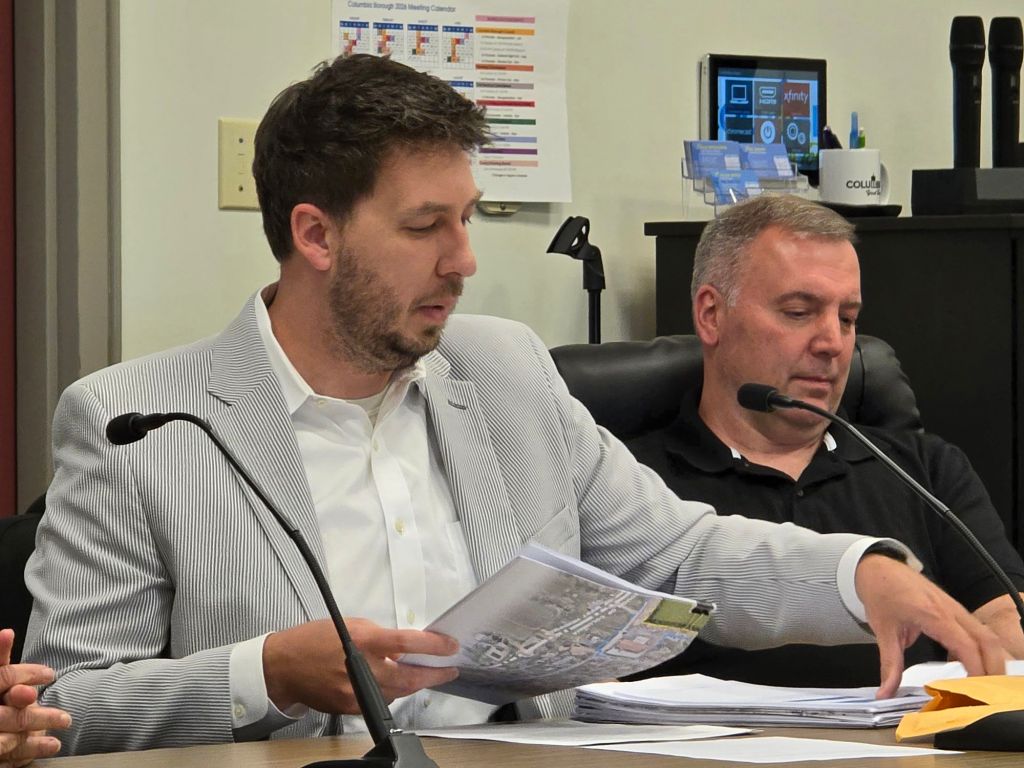
Borough Solicitor Evan Gabel and Borough Manager Jack Brommer review a bid proposal from Saadia Holding LLC Monday morning, May 18th, at Borough Hall.
JOE LINTNER | COLUMBIA SPY
Columbia Borough has received one bid for the sale of 41 acres of the former McGinness property at 1020 Manor Street. The bid proposal, submitted by Saadia Holding LLC, is in the amount of $6,350,000.
The proposal exceeds the minimum required bid of $6.2 million by $150,000.
Evan Gabel, borough solicitor, opened and reviewed the proposal with borough officials at a public meeting at Borough Hall on Monday morning, May 18. The package included documentation on the organization and project team, a land use proposal with scope of work, estimated job creation figures, a financing section, community benefits, traffic impact analysis, a project timeline, and a sketch plan.
The company has also committed to providing the required 4% deposit within 10 days. “We have everything we need to consider this a responsive bid,” Gabel said.
Borough Council will hold an executive session Monday, May 18, at 7 p.m. to discuss the proposal. A decision on the bid is expected to be made at the regular council meeting on Tuesday, May 26, at 7 p.m. at Borough Hall.
In early 2026, Columbia Borough Council announced a Request for Proposals for the purchase and redevelopment of 41.388 acres at the site. The RFP, officially released on March 30, 2026, sought an experienced developer to purchase and transform the property into a development that would expand the borough’s tax base and create jobs.
The Columbia Memorial Day Ceremony and Parade will be held at noon Sunday, May 24. Theme: “Honoring All Columbia Fallen Veterans.” Event kicks off with Bainbridge Band patriotic concert in Locust Street Park in the gazebo, followed by a Memorial Day parade at 2:30 p.m.
First of all, your dedicated correspondent must thank the Columbia Spy for the privilege of publishing her column in this space, which will now appear weekly on Sunday mornings and will focus on the doings in Columbia in this, its 300th year.
And now, it is with a heart most tenderly divided — between the keenest anxiety and the most cautious optimism — that your devoted correspondent takes up her quill to address the matter of Columbia Borough’s financial affairs. The present circumstances demand not merely attention, but earnest contemplation.
Let us begin with the unvarnished truth: with a budget of over $9 million required to sustain Borough operations and yet a total of only $2.3 million presently in hand, one need not possess the mathematical acumen of a Cambridge scholar to perceive that the ledgers are in considerable distress. One notes, with charitable restraint, that the Borough has been conducting its fiscal affairs entirely without the guidance of a finance manager for several months past.
In February of this year, the Borough Council voted unanimously to seek a bridge loan of $2 million to carry the municipality through the treacherous financial waters of early 2026. This, following a tax increase to 10 mills in 2024 that proved insufficient. Whether said loan was ultimately approved remains unclear.
The previous year closed with a shortfall exceeding one million dollars. Rather than raise taxes, the Council drew upon reserves — reducing them to a mere $300,000, a figure officials themselves have called “uncomfortably low.” Your correspondent would suggest that is a phrase of considerable understatement.
Among the Borough’s additional financial obligations: the Columbia Market House continues to operate at a loss since its multi-million dollar renovation and 2019 reopening, with Council Vice President Heather Zink suggesting it shall remain “in the red” for the foreseeable future. The Columbia Crossing building requires $500,000 in repairs. The recently acquired Ridge Avenue property will demand several millions more to ready it as the Borough sheds. And a series of municipal bonds (originally $9 million) taken out a decade ago remain outstanding. The list continues.
Further unsettling news arrives in the form of Truist Bank, which shall depart Columbia Borough on July 28, 2026, leaving the community without a banking institution. One council member said this is the third time in ten years in which a bank has left the Borough. Most remarkable is the Council President’s candid admission that he is uncertain how one attracts a replacement bank, or indeed whose responsibility that task might be. One hopes clarity on this matter arrives before July.
And yet, your correspondent insists upon this point: Not all is doom and gloom. Borough officials are actively pursuing several avenues of relief: the sale of the former McGinness property, for which bids (if any) will be opened on Monday, May 18th with a minimum of $6.2 million; the sale of Borough sheds and the former Front Street firehouse; and the long-anticipated receipt of $1.75 million in state RACP funds for the Market House — though hopes for that particular sum diminish with each passing season.
Should these transactions proceed favorably, a large tax increase may yet be avoided for 2027, and Columbia Borough may find itself upon considerably firmer ground.
(This correspondent must also note with sadness the impending closure of Historic Salem United Church of Christ on Walnut Street — founded in 1803 and the oldest congregation in the Borough — which shall merge with Trinity UCC in Mountville after more than two centuries of faithful presence in Columbia.)
In short, the challenges are real and they are serious. But communities of character have navigated troubled waters before, and this correspondent has every confidence that Columbia possesses the resolve to see it through.
With warmest regards and the most vigilant of quills,
Your Most Devoted Correspondent,
Lady Whistletown
P.S.,The views expressed herein are offered in the spirit of civic transparency and community concern, with no malice toward any individual — only the deepest affection for Columbia Borough and all who call it home.