Author: SPY
Poster contest for Industrial Hemp Awareness Fair – Winner will be featured in local businesses and online!
Calling all 18 and under…would you like to create the advertising Poster for the Industrial Hemp Awareness Fair?
If so, please design a Poster With Facts about Industrial HEMP and include the name of the Event, location, date and time and submit it to: susanlove616.sl@gmail.com RE: Industrial Hemp Awareness Fair.
The winning Poster will be featured in local Businesses and on the Borough’s FB page as well as the Event page.
You will also be recognized at the Awareness Fair.
Thank you for your participation.
Agenda – School Board Meeting – February 20, 2020
What's up with that mural in the Columbia Post Office? Here's the story
Columbia History – Did you know?
Did you know the mural in the Columbia Post Office lobby was commissioned by the U.S. Department of the Treasury? It’s true!
The painting “Columbia Bridge” by artist Bruce Mitchell was commissioned by the Treasury Department’s Section of Painting and Sculpture (later named the Section of Fine Arts) in the 1930s. “The Section,” as it was known, funded such murals as part of the cost of new post office construction, with 1% set aside for artistic enhancements. Mitchell completed the oil-on-canvas painting in 1938, three years after the completion of the post office at 53 North 4th Street. The canvas is attached to the inside north wall of the post office, just above the door to the postmaster’s office.
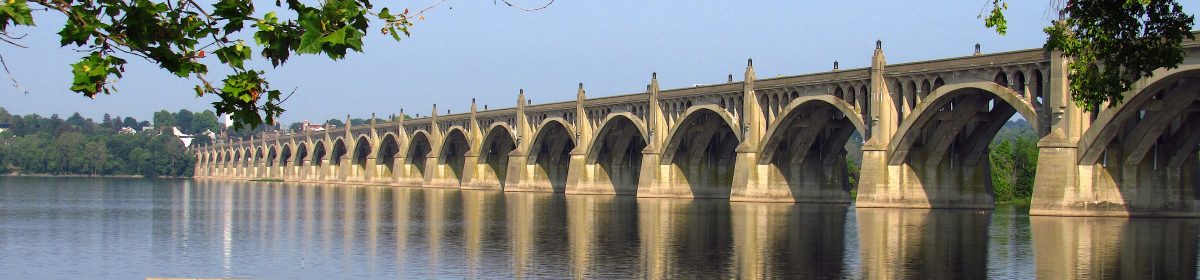
The mural depicts 1850s Columbia Borough and shows a man astride a horse, carrying a bag marked “U.S. MAIL.” The horse and rider are positioned before a red building, presumably a post office. A Conestoga wagon pulled by two horses is about to enter a covered bridge via a snow-covered road. A small train is also about to enter the bridge, on an attached side structure. In the center of the painting, a small footbridge connects to an islet containing a small red building. Government authorities initially thought the rendition of the bridge was inaccurate, but the artist prevailed despite the criticism. Mitchell noted that the bridge was the longest such structure in the world at the time. The bridge depicted is almost certainly the second Columbia-Wrightsville Bridge, which was completed in 1834 and burned on June 28, 1863 during the Civil War. [The actual bridge piers can still be seen today, just north of the Veterans Memorial Bridge.]
Unlike other New Deal programs such as the Works Progress Administration (WPA), the mural commissions were not a relief program but were selected from the winners of national and local art competitions. Almost 850 artists were commissioned to paint 1,371 murals, most of which were installed in post offices; 162 of the artists were women and three were African American.

Artists were asked to paint in an “American scene” style, depicting ordinary citizens in a realistic manner, and were encouraged to produce works appropriate to the communities where they were to be placed while avoiding controversial subjects. The murals were intended to boost the morale of Americans enduring the Great Depression by depicting uplifting subjects. Some people objected to the murals, however, believing the very idea was communist, because Soviet Russia was also making them at the time.
More than 1,200 original works of art were commissioned for post offices nationwide. Of those, 88 were in Pennsylvania and about 80 survive today. Of the original 88, about half were sculptures. Murals were usually painted on canvas but sometimes as frescos. Pennsylvania has the second largest number of such murals, behind New York.
Sources:
https://digitalcommons.unf.edu/historical_architecture_main/3573/
https://newdealartregistry.org/artist/Mitchellbruce/
https://livingnewdeal.org/projects/post-office-columbia-pa/
http://www.wpamurals.com/pennsylv.htm
https://en.m.wikipedia.org/wiki/List_of_United_States_post_office_murals
https://lancasteronline.com/news/such-a-deal/article_2ab0cfa5-6b5b-553b-b4f6-7e43615bf992.html
https://en.m.wikipedia.org/wiki/Columbia%E2%80%93Wrightsville_Bridge
Tuesday, Feb. 18, at the Library
After slow start, Columbia tops Lancaster Mennonite 68-58 in District 3 Class 3A boys basketball quarterfinals
After twice beating Lancaster Mennonite in the regular season to capture the L-L Section Five crown, Columbia completed the season sweep of the Blazers with Monday’s win.
With the victory, Columbia (17-7) advanced to the district semifinals for the sixth time in nine years, second time under fourth-year coach Kerry Glover, and first time since 2017. Columbia also qualified for the PIAA Class 3A tournament.
Columbia Borough Meetings – Week of February 17, 2020
Counterfeit $100 bill suspect | Columbia Borough Police Department
Sourced via CRIMEWATCH®: https://lancaster.crimewatchpa.com/columbiapd/10552/cases/counterfeit-100-bill-suspect
What IS the name of that bridge, anyway?
Columbia's "Returned Soldier" has a twin brother in New York
Columbia History – Did you know?
An identical statue, called “The Woodside Doughboy,” stands in Doughboy Plaza in Woodside, Queens, New York. The design was created by sculptor Burt W. Johnson and was dedicated on Memorial Day 1928, a decade after the end of World War I. The New York statue is the original. Columbia’s is a replica.
The original (shown here), known as “The Woodside Doughboy, stands in Woodside Plaza,” in Woodside, Queens, NY.
(Photo by Cmprince, posted on Wikipedia)
Here’s the backstory: The New York monument was commissioned by the Woodside Community Council at a cost of $5,000 after Johnson’s concept took first prize in a war memorial competition. The purchase contract included a stipulation that a copy would never be made or sold.
However, Columbia wanted a war memorial of its own. After scouting around and discovering Woodside’s monument, a Columbia memorial committee contacted the sculptor’s widow, Ottilie Johnson. [Burt Johnson died on March 27, 1927.] The committee explained that it was impressed with her husband’s work and persuaded her to contact Woodside officials and revisit the contract.
With its payment of $1,000 to Woodside, the committee obtained permission to have a duplicate made for Columbia, thanks to Mrs. Johnson. In an agreement with Johnson, the committee contracted the Roman Bronze Company [now operating as Roman Bronze Studios] in Corona, Queens, NY to cast the replica.
The monument was dedicated as a “Memorial to All the Wars” at a 4 p.m. ceremony on Memorial Day 1928. Over 3,000 people from all parts of the county attended, including veterans of the Civil War, Spanish-American War and World War I. It was the first permanent memorial to be placed in Columbia.
In 1928, the American Federation of Arts selected the Woodside Doughboy as the best war memorial of its kind, an honor that could also be bestowed on Columbia’s “Returned Soldier.”